|
How the early production of transistors at RCA came
into being can best be described by my giving an account of our early
transistor work as I remember it at RCA. The first transistor experiments
in our laboratory was the point contact type. These transistors were not
rugged enough to really interest our radio circuit designers. It was only
when we appreciated the real advance of p-n-p junction devices that
progress was rapidly made.
In my
laboratory in the early 1950’s we were constantly building transistors one
junction at a time. The base was a thin .001 to .002 inch thick strip of
single-crystal germanium. The collector was a .015 round ball of indium
which was heated to about 450 degrees C. in a hydrogen furnace to melt and
alloy this dot with the germanium. On cooling and hardening the collector
junction was formed. The wafer was then turned over and a slightly smaller
emitter junction alloyed to germanium on the opposite side. After
attaching the base and the 2 dots of indium to a suitable glass stem and
carefully enclosing the parts in plastic we would have a sturdy transistor.
Then, of course, we made jigs holding six transistors
for the alloying in the hydrogen furnaces. When we got to making six
measurable transistors, we were all very happy. This was “mass”
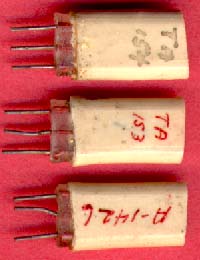
production. (Editor’s Note: The model number TA-153 was assigned to this
earliest pnp alloy junction developmental transistor type.)
NOTE:
This website has been moved. Use this link to continue.
|